Gamification in Quran Learning: Why It Works and How to Use It


Bilal Chohan
26 October 2025
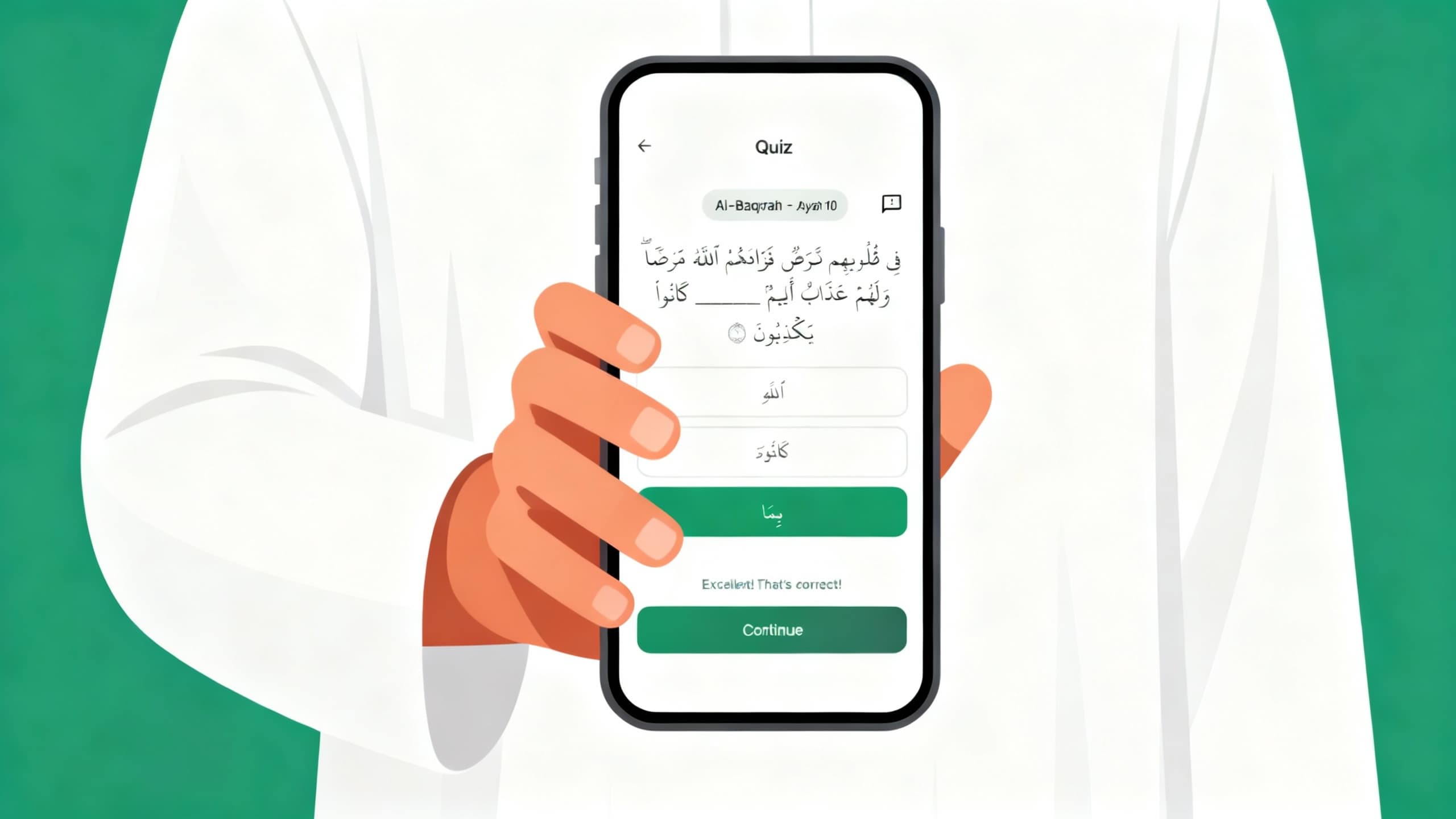
Gamification in Quran Learning: Why It Works and How to Use It
When you open Duolingo, you're greeted with colorful animations, cheerful sounds, and a streak counter reminding you not to break your 47-day learning chain. It's fun, it's engaging, and most importantly—it works. Millions of people have learned new languages through an app that feels more like a game than a classroom.
Now imagine applying that same psychological framework to something infinitely more important: memorizing the Quran.
For some, this idea feels uncomfortable. Can the sacred words of Allah be paired with points, badges, and leaderboards? Isn't there something irreverent about "gamifying" Quran memorization?
These are valid questions, and they deserve thoughtful answers. The truth is that gamification, when done with proper intention and balance, isn't about trivializing the Quran—it's about honoring it by creating sustainable practices that help you engage with Allah's words consistently, joyfully, and for a lifetime.
This guide explores the science behind gamification, its compatibility with Islamic learning traditions, and how to use it effectively for Quran memorization without losing sight of what truly matters: connecting with your Creator.
Introduction: Can Learning Quran Be Fun?
Let's address the elephant in the room: is it even appropriate to describe Quran learning as "fun"?
The answer requires nuance. The Quran is not entertainment. It's divine guidance, the literal speech of Allah, and the foundation of our faith. Approaching it with reverence, humility, and seriousness is non-negotiable.
But here's what's equally true: Allah created human beings with natural inclinations toward enjoyment, achievement, and social connection. These aren't bugs in our design—they're features. And when channeled properly, they can become powerful tools for drawing us closer to the Quran rather than pushing us away.
The Historical Context
Throughout Islamic history, teachers have understood that effective learning requires engagement, not just obligation. The Prophet (peace be upon him) himself used varied teaching methods to keep companions engaged: he told stories, asked questions, drew diagrams in the sand, and created memorable phrases that stuck in people's minds.
Companion Abdullah ibn Abbas was known for making Quran learning enjoyable for young students, using methods that captured their attention and made lessons memorable. The great scholars didn't view engagement and reverence as opposing forces—they saw them as complementary.
The Modern Challenge
Today's learners face unprecedented distractions. Social media apps are engineered by teams of psychologists and designers whose sole job is capturing and holding your attention. TikTok, Instagram, YouTube—these platforms have mastered the art of making content irresistible.
If Quran learning feels like a boring chore while mindless scrolling feels effortless and enjoyable, which one will win in the long run?
This isn't a theoretical question. Millions of Muslims genuinely want to memorize the Quran but consistently choose Instagram over their Mushaf, not because they don't value the Quran, but because one activity triggers dopamine and the other triggers guilt and difficulty.
Gamification as a Bridge
Gamification doesn't make the Quran less serious—it makes engaging with the Quran more sustainable. It meets people where they are, acknowledging that human psychology responds to feedback, progress, and achievement, then channels those responses toward spiritual growth.
The goal isn't to make Quran memorization "fun" in the way a video game is fun. The goal is to remove unnecessary friction, provide encouraging feedback, and create positive reinforcement loops that make consistent practice the path of least resistance.
When a student opens Mathani and sees their 30-day streak, feels the satisfaction of earning a new badge, or feels motivated by healthy competition on a leaderboard, they're more likely to engage with the Quran today. And that engagement, repeated daily, transforms lives.
What is Gamification?
Before we discuss whether gamification belongs in Quran learning, we need to understand what it actually is.
The Definition
Gamification is the application of game design elements and psychological principles to non-game contexts to increase engagement, motivation, and behavior change. It's not about turning everything into a literal game—it's about leveraging the psychological mechanisms that make games compelling.
The Core Elements
The most common gamification elements include:
Points and Scoring Systems: Measurable feedback that quantifies progress. In Mathani, this might be verses memorized, review sessions completed, or consistency metrics.
Levels and Progression: Clear stages of advancement that provide a sense of growth. Moving from "Beginner" to "Advanced" to "Hafiz in Training" gives users a roadmap and identity.
Streaks: Consecutive days of activity that create psychological investment. The longer your streak, the more motivated you are to maintain it.
Badges and Achievements: Visual markers of specific accomplishments that serve as both motivation and social proof.
Leaderboards: Comparative rankings that tap into healthy competitive instincts and community connection.
Challenges and Quests: Specific, time-bound goals that create focus and urgency.
Progress Bars: Visual representations of advancement toward a goal that make abstract progress concrete and visible.
The Psychology Behind It
Gamification works because it taps into fundamental human psychological needs:
Autonomy: The feeling of control over your own actions and choices. Good gamification gives users agency rather than dictating their path.
Competence: The need to feel capable and effective. Progress bars and achievement badges provide evidence of growing skill.
Relatedness: The desire for connection with others. Leaderboards and community features fulfill this need.
Progress Visibility: Humans are motivated by seeing tangible progress. When growth is invisible or abstract, motivation wanes. Gamification makes progress concrete and visible.
Immediate Feedback: Unlike traditional learning where you might not know how well you're doing for weeks, gamification provides instant feedback. You know immediately whether you've maintained your streak or earned a badge.
The Dopamine Factor
Here's the neurological reality: when you complete a task and receive positive feedback (a badge, a point, a level-up), your brain releases dopamine. This isn't shallow or manipulative—it's how human brains reinforce behaviors that lead to survival and success.
Traditional Quran memorization provides delayed gratification—you might not feel the full spiritual reward until years into your journey. Gamification provides immediate gratification along the way, creating a positive feedback loop that sustains long-term commitment.
What Gamification Is NOT
It's important to clarify misconceptions:
- Gamification is NOT turning the Quran into a video game
- It's NOT making learning trivial or shallow
- It's NOT replacing intrinsic spiritual motivation with extrinsic rewards
- It's NOT manipulating people into doing things against their interests
Good gamification enhances existing motivation and removes barriers to action. It's a tool, not a replacement for genuine spiritual connection.
Islamic Perspective on Motivation and Learning
Before embracing gamification for Quran learning, we need to examine whether it aligns with Islamic principles of motivation, intention, and worship.
The Importance of Intention (Niyyah)
In Islam, the intention behind an action determines its spiritual value. The Prophet (peace be upon him) said, "Actions are judged by intentions, and every person will get the reward according to what he has intended" (Bukhari).
The critical question isn't whether gamification elements exist—it's whether they corrupt your intention or support it.
If you're memorizing the Quran primarily to climb a leaderboard or show off badges, your intention is misaligned. But if you're using these tools to maintain consistency in your worship, to push through difficult moments, and to build a habit that brings you closer to Allah, then gamification serves your intention rather than replacing it.
Historical Precedents for Positive Reinforcement
Islamic educational tradition is rich with examples of positive reinforcement and motivation:
The Use of Praise: The Prophet (peace be upon him) frequently praised companions for their efforts, creating motivation through recognition. When Abu Bakr was the first to respond to certain calls, the Prophet acknowledged this publicly.
Competitive Virtue: The Quran itself encourages healthy competition in good deeds: "So race to all that is good" (Al-Baqarah 2:148). The companions competed to be first to prayer, most generous in charity, and most dedicated in worship.
Rewards and Promises: Allah promises specific rewards for specific actions throughout the Quran. The entire concept of Jannah and its levels is, in a sense, the ultimate achievement system—different levels of paradise for different levels of faith and deed.
Visual Progress Markers: Traditional madrasas often used physical markers of progress—completing a section, receiving ijazah, wearing specific garments. These are pre-digital forms of achievement recognition.
The Difference Between Riyaa and Healthy Motivation
Riyaa (showing off) is performing worship to be seen and praised by others. This is explicitly forbidden and spiritually destructive.
But there's a crucial difference between:
- "I'm memorizing Quran so people think I'm pious" (riyaa)
- "I'm motivated to maintain my streak because I've committed publicly to this goal and I don't want to disappoint myself or my community" (healthy accountability)
The first seeks human praise as the end goal. The second uses community accountability as a means to achieve a sincere spiritual goal.
The Concept of Adab (Proper Conduct)
Any gamification of Quran learning must maintain proper adab toward the Quran. This means:
- Never treating verses as mere content to accumulate points
- Maintaining focus on meaning and understanding, not just memorization speed
- Reciting with proper tajweed and reverence
- Approaching the Quran in a state of wudu and with respect
- Never creating competitive elements that lead to rushing through verses without comprehension
Apps like Mathani must (and do) design their gamification elements to encourage these behaviors, not undermine them.
The Scholar's Perspective
Contemporary Islamic scholars have increasingly acknowledged that modern tools, including gamified learning, can serve Islamic education when used properly. The key criteria are:
- Does it increase engagement with the Quran?
- Does it maintain proper reverence and adab?
- Does it support sincere intentions rather than replacing them?
- Does it prioritize quality of memorization over mere quantity?
When these criteria are met, gamification becomes a permissible and even praiseworthy tool.
The Ultimate Motivation
No badge, streak, or leaderboard can compare to the intrinsic motivation of knowing you're engaging with the words of Allah. The goal of gamification is to help you show up consistently so that the deeper, spiritual rewards can take root.
Think of it like training wheels on a bicycle. Initially, you need the external support. But over time, as your relationship with the Quran deepens, the external motivators become less important. You continue not because you need to maintain a streak, but because you've fallen in love with the Quran itself.
That's the true success of gamification—when it becomes unnecessary.
Streaks: Building the Habit of Daily Review
The streak counter is perhaps the most powerful and most controversial element of gamification. A simple number showing consecutive days of activity has proven capable of changing lives—but it's also been criticized as manipulative.
Let's examine why streaks work and how to use them properly for Quran memorization.
The Psychology of Streaks
When you see "47-day streak" on your screen, something psychological happens: you've created what behavioral economists call "sunk cost." You've invested 47 days of effort, and breaking the streak would waste that investment.
This isn't manipulation—it's leveraging a natural human tendency toward consistency. Once we commit to something and see visible progress, we're psychologically motivated to continue.
The Minimum Viable Action
Here's the beautiful thing about streak-based apps: they don't require perfection, just presence. To maintain your Mathani streak, you might only need to review 5 verses. That's achievable even on your worst, busiest, most chaotic day.
This "minimum viable action" approach solves one of the biggest obstacles to consistency: all-or-nothing thinking. Traditional approach says, "I need a full 30-minute session or there's no point." Streak thinking says, "I just need to show up, even if only for 2 minutes."
Showing up for 2 minutes is infinitely better than showing up for 0 minutes. And here's the secret: once you've shown up, you often do more than the minimum. The hardest part is starting—streaks eliminate the daily decision of whether to start.
The Streak as Spiritual Discipline
In Islamic tradition, consistency in small acts is praised over sporadic grand gestures. The Prophet (peace be upon him) said, "The most beloved of deeds to Allah are those that are most consistent, even if they are small" (Bukhari).
A streak is the digital manifestation of this principle. It trains you in istiqamah (steadfastness), one of the most important spiritual qualities.
When Streaks Become Problematic
Streaks can become unhealthy in several scenarios:
Anxiety and Pressure: If maintaining your streak creates overwhelming anxiety or you're losing sleep worrying about it, the tool has become counterproductive.
Mechanical Practice: If you're rushing through your review just to "check the box" without any presence or reflection, you're not actually engaging with the Quran meaningfully.
Streak Over Substance: If you prioritize the streak over the quality of memorization, reciting incorrectly just to maintain the number, you've lost the plot.
Guilt When Breaking: If breaking a streak causes such guilt that you give up entirely, the streak has failed its purpose.
How to Use Streaks Wisely
To leverage streaks without falling into these traps:
Set Realistic Minimums: Your daily minimum should be achievable even on your worst day. Three verses reviewed is better than "one full page" that you'll fail on busy days.
Build in Grace: Use apps that allow streak freezes for legitimate reasons (illness, travel, emergencies). Mathani's streak protection features acknowledge that life happens.
Celebrate Milestones: When you hit 30 days, 100 days, or a full year, pause to reflect on how much Quran you've engaged with thanks to this simple tool. This reflection reconnects you to the deeper purpose.
Track Multiple Metrics: Don't let the streak be your only measure of success. Also track verses mastered, tajweed improvements, and spiritual insights gained.
Restart Without Shame: If you break a streak, restart immediately. Don't wait until Monday or next month. The next best time after yesterday is today.
The 30-Day Transformation
Behavioral research suggests it takes approximately 30 days of consistent practice to form a habit. After 30 days of daily Quran engagement, you'll notice something shift—it starts to feel strange NOT to engage with the Quran. The habit has taken root.
This is where the streak's true power lies: it bridges you through the difficult early phase until intrinsic motivation and habit take over.
Streaks and Accountability
Many Mathani users share their streaks with accountability partners or family members. This adds a social dimension—you're not just maintaining the streak for yourself, but you've created gentle accountability with others who support your goal.
This transforms the streak from a private metric to a shared commitment, adding another layer of motivation.
Achievement Badges and Spiritual Growth
Badges and achievements might seem like childish digital stickers, but the psychology behind them is surprisingly profound and can be leveraged for genuine spiritual growth.
What Makes Badges Motivating
Badges work because they:
Provide Concrete Milestones: "Memorize Surah Al-Mulk" is clearer and more motivating than vague goals like "memorize more Quran."
Create a Collection Mentality: Humans are natural collectors. Once you've earned a few badges, you want to complete the set.
Offer Variety: Different types of achievements (speed milestones, consistency achievements, difficulty challenges) appeal to different personality types and keep engagement fresh.
Serve as Progress Markers: Looking back at your earned badges provides tangible evidence of how far you've come, which is crucial during plateaus.
Enable Storytelling: Each badge represents a chapter in your memorization journey. "This is when I finally mastered Surah Yaseen" becomes part of your personal narrative.
Types of Meaningful Achievements for Quran Memorization
Well-designed achievement systems for Quran learning might include:
Consistency Badges: 7-day streak, 30-day streak, 100-day streak, one-year streak Milestone Badges: First surah completed, first juz completed, 10 juz completed Difficulty Badges: Memorized one of the long surahs, mastered difficult tajweed rules Speed Challenges: Reviewed 100 verses in one week, completed daily goals for 30 days straight Quality Markers: Perfect recitation with no mistakes for 7 days, completed understanding assessment Special Events: Ramadan champion (extra engagement during Ramadan), Tahajjud reciter (night review sessions)
The Spiritual Dimension
Here's where badges can transcend mere gamification and become spiritually meaningful: each badge can represent not just an accomplishment, but a station (maqam) in your spiritual journey.
When you earn "Surah Al-Kahf Master," you're not just collecting a digital sticker—you're marking that you now have the Friday surah in your heart, ready to recite in your prayers, ready to reflect upon its meanings.
When you earn "100-Day Consistent Reviewer," you're marking a transformation in your character. You've become someone who shows up, someone who has istiqamah, someone who honors their commitments.
Avoiding Badge-Focused Distortion
The risk with badges is pursuing them for their own sake rather than for the underlying spiritual growth they represent.
Warning signs that badges have become unhealthy:
- You're rushing through memorization to earn badges rather than memorizing properly
- You're comparing your badges to others with jealousy or pride
- You feel genuinely upset when you don't earn a badge you were trying for
- You've lost interest in Quran engagement that doesn't result in badges
Healthy Badge Engagement
To use badges properly:
View Them as Suggestions, Not Mandates: Badges show you possible paths, but your personal Quran journey might look different, and that's fine.
Celebrate Privately: When you earn a badge, make dua and thank Allah for enabling you to reach this milestone. The real achievement is the memorization, not the digital reward.
Share Thoughtfully: If you share badge achievements, frame them as gratitude and encouragement for others, not as showing off.
Disconnect Worth from Badges: Your value as a Muslim isn't measured by your badge collection. Someone with zero badges but sincere intention and one surah memorized may be more beloved to Allah than someone with all the badges but arrogance in their heart.
For Different Learning Styles
Achievement systems appeal particularly to certain personality types—those who are goal-oriented, competitive, or collection-focused. If you're not naturally motivated by badges, that's perfectly fine. Use the features that resonate with you and ignore those that don't.
The beauty of good app design is offering multiple paths to the same destination.
Leaderboards: Healthy Competition in the Muslim Community
Leaderboards are perhaps the most controversial gamification element for Quran learning. Competition has the potential to bring out the best in us—or the worst. Let's explore how to harness leaderboards for good.
The Islamic View on Competition
The Quran explicitly encourages competition in good deeds: "Race toward forgiveness from your Lord and a Garden as wide as the heavens and earth" (Al-Hadid 57:21).
The companions competed constantly—to be first to prayer, most generous in charity, most knowledgeable in Quran. This wasn't condemned; it was praised.
But there's a crucial difference between competing to excel and competing to feel superior. The first is spiritual striving; the second is spiritual poison.
How Leaderboards Can Be Healthy
When designed and used properly, leaderboards can:
Create Community Connection: Seeing others on similar journeys creates a sense of belonging. You're not alone in your struggle and progress.
Provide Motivation Through Peers: When you see someone with similar circumstances making impressive progress, it proves what's possible and motivates you to rise to that level.
Add Positive Pressure: Gentle accountability to a community can help you show up on days when personal motivation is low.
Normalize Dedication: In a culture where people readily share Netflix binges but hide their worship, public leaderboards normalize making Quran a priority.
Enable Mentorship: Advanced learners on leaderboards can become informal mentors, offering advice and encouragement to those earlier in the journey.
How Leaderboards Can Be Harmful
The risks are real:
Envy and Jealousy: Seeing someone ahead of you can trigger unhealthy comparison and resentment.
Pride and Arrogance: Being at the top can inflate your ego and lead to spiritual self-satisfaction.
Discouragement: If you're consistently at the bottom, you might feel like a failure and give up.
Rushing and Cheating: Pressure to rank higher might lead to rushing through verses without proper memorization or even faking activity.
Loss of Sincerity: Competing for rank rather than competing for Allah's pleasure corrupts your intention.
Mathani's Approach to Healthy Competition
Well-designed Quran apps implement several features to maximize benefits while minimizing harms:
Private Leaderboards: Compete only with friends or family you've chosen, not strangers.
Multiple Metrics: Rank by different measures (consistency, quality, variety) so there are multiple ways to "win."
Opt-In System: Leaderboards should be optional. If they don't serve your spiritual journey, turn them off.
Focus on Improvement: Some leaderboards show personal progress against your past self, not against others.
Celebration Over Comparison: When someone achieves something notable, the community congratulates rather than competes.
Anonymous Options: Some users prefer to contribute to community energy without personally being ranked.
How to Engage with Leaderboards Spiritually
If you choose to use leaderboards:
Set Your Intention: Before looking at rankings, remind yourself: "I'm using this tool to stay motivated in my worship of Allah, not to feel superior to others."
Practice for Others: When someone ranks higher, make dua for them. "May Allah bless them and increase them" is the proper response, not envy.
Practice for Yourself: When you rank higher, immediately think: "This is only by Allah's grace, and tomorrow I could fall behind. What matters is His pleasure, not this number."
Focus on the Journey: Look at leaderboards to gauge general activity and community energy, not to fixate on your exact position.
Take Breaks: If you notice leaderboards triggering unhealthy emotions, take a break from viewing them. Your Quran journey doesn't need them to be valid.
The Competition That Matters
Ultimately, the only competition that matters is with your previous self. Are you more consistent than last month? Have you memorized more than last year? Are you closer to Allah than you were?
If a leaderboard helps you answer "yes" to these questions, use it. If it doesn't, ignore it. The scoreboard that matters is in the Heavens, not on your screen.
How Mathani Balances Fun with Reverence
Creating an app that makes Quran memorization engaging without being disrespectful is a delicate balance. Mathani's design philosophy offers a template for how to achieve this balance.
The Core Principles
Reverence First: Every design decision starts with the question: "Does this maintain proper adab toward the Quran?" If not, it's rejected, no matter how engaging it might be.
Substance Over Style: Gamification elements enhance the learning experience but never replace quality content, proper tajweed, or meaningful engagement with the text.
User Agency: Features are opt-in rather than mandatory. If streaks stress you out, turn them off. If leaderboards help you, use them. The app serves the user's spiritual journey, not the other way around.
Meaning Alongside Memorization: Good apps integrate translation, tafsir, and context alongside memorization, ensuring users understand what they're committing to memory.
Quality Gates: Gamification doesn't reward quantity at the expense of quality. Systems are designed to encourage proper pronunciation, accuracy, and retention, not just speed.
Design Elements That Maintain Reverence
Subtle Aesthetics: Unlike flashy game apps with loud colors and aggressive animations, Quran apps should use calming color palettes, elegant typography, and minimal distractions.
Appropriate Feedback: Instead of cartoon celebrations when you complete a session, perhaps a gentle checkmark and a relevant hadith about the rewards of Quran recitation.
Contextual Reminders: Notifications that remind you to practice should feel like gentle spiritual nudges, not aggressive marketing tactics. "The best of you are those who learn the Quran and teach it" is more appropriate than "Don't lose your streak!"
Sacred Text Treatment: The Quranic text itself is never altered, never presented alongside irreverent imagery, and always displayed with appropriate formatting and respect.
Wudu Reminders: Some apps include gentle reminders about the adab of Quran recitation, including being in a state of wudu and facing the qiblah when possible.
The Spaced Repetition Algorithm
One of Mathani's most powerful features isn't flashy or game-like at all—it's the spaced repetition algorithm that determines which verses you should review and when.
This algorithm is based on cognitive science research about optimal intervals for long-term retention. It's not "fun" in the traditional sense, but it's incredibly effective, ensuring that your memorization actually lasts.
This represents the right priority: effectiveness over entertainment, substance over flash.
Community Features Done Right
Community features can either enhance or detract from reverence. Mathani implements them thoughtfully:
Shared Goals, Not Comparison: Instead of "You're ranked #47," the focus is "You and 1,200 others are working on Surah Yaseen this month."
Encouragement Over Competition: Comments and interactions emphasize mutual support rather than one-upmanship.
Private by Default: Your progress is private unless you choose to share, preventing unwanted attention or pressure.
Scholarly Input: Community discussions can include input from knowledgeable moderators to prevent misinformation about tajweed or meanings.
The Dopamine Balance
Good gamification provides enough positive feedback to keep you engaged but not so much that you become addicted to the app rather than the Quran.
The goal is that eventually, the deepest reward comes not from earning a badge but from the spiritual sweetness of reciting Quran from memory in your tahajjud prayer. The external gamification gradually becomes less necessary as internal spiritual motivation grows.
What Mathani Doesn't Do
Just as important as what the app includes is what it excludes:
No Manipulative Tactics: No countdown timers creating false urgency, no spam notifications, no artificial scarcity.
No Ads: The Quran should never be displayed alongside commercial advertising. The business model must respect the content's sanctity.
No Trivializing Elements: No cartoon mascots, no silly sound effects, no meme culture integration that would diminish the Quran's dignity.
No Exploitative Monetization: No pay-to-win features, no loot boxes, no psychological tricks to extract money from vulnerable users.
The Ultimate Test
The question to ask about any Quran app's gamification: Would a sincere scholar approve of this approach? Would the companions have seen this as honoring the Quran or disrespecting it?
If the answer creates doubt, the feature shouldn't exist—no matter how engaging it might be.
For Parents: Gamification for Children's Hifz
Children's brains are uniquely suited to benefit from gamification, but they're also particularly vulnerable to its potential downsides. Parents need specific guidance on using these tools for their children's Quran memorization.
Why Children Respond to Gamification
Children's executive function—the ability to pursue long-term goals despite short-term discomfort—is still developing. They struggle with delayed gratification more than adults.
Gamification provides the immediate feedback and short-term rewards that make long-term goals accessible to young minds. A 7-year-old can't conceptualize the long-term benefits of Quran memorization, but they can understand earning a badge today.
Age-Appropriate Approaches
Ages 4-6: Play-Based Learning At this age, memorization should be almost entirely play-based. Short verses, lots of repetition, songs and melodies, and physical movement. Gamification at this age is very light—perhaps stickers on a chart for each surah memorized.
Ages 7-10: Gentle Gamification This is the sweet spot for introducing apps like Mathani. Children this age can understand streaks, enjoy earning badges, and feel motivated by progress bars. But they need parental involvement—reviewing together, celebrating achievements together, and keeping sessions short (10-15 minutes).
Ages 11-14: Increasing Independence Older children can take more ownership of their memorization journey. They can handle leaderboards (with guidance about healthy competition), set their own goals, and manage longer sessions. Parents shift from direct supervision to oversight and encouragement.
Ages 15+: Adult Approaches Apply Teenagers can use gamification tools much like adults, though they may need extra support around social comparison and perfectionism.
The Parent's Role
Parents shouldn't just hand a child a tablet with Mathani and disappear. Your role includes:
Co-Learning: Especially with younger children, sit together during practice. Your presence makes it quality time, not just Quran time.
Enthusiasm Reflection: Children take emotional cues from parents. If you're genuinely excited about their badge, they'll be excited. If you're dismissive, it loses meaning.
Translation and Context: Don't let gamification replace actually understanding the Quran. Explain what the verses mean in age-appropriate terms.
Balanced Praise: Praise effort and consistency over outcomes. "I'm proud that you practiced every day this week" is better than "I'm proud you're ahead of your friend."
Monitoring Emotional Response: Watch for signs that gamification is creating unhealthy patterns—obsession, anxiety, pride, or devastation at setbacks.
Benefits for Children
When used well, gamification helps children:
Build Discipline: Daily practice becomes routine, teaching valuable life skills beyond Quran.
Associate Quran with Positivity: Instead of Quran time being forced drudgery, it becomes something they look forward to.
Measure Progress: Children need concrete evidence of growth. Seeing their badge collection or progress bar fill gives them that evidence.
Develop Healthy Habits Early: A child who starts building a daily Quran habit at age 8 has a tremendous head start on spiritual development.
Gain Confidence: Successfully memorizing Quran, reinforced by achievements and parental celebration, builds genuine self-esteem.
Risks to Avoid
Comparison Culture: If children constantly compare their progress to siblings or classmates, it can breed jealousy and resentment.
Extrinsic Motivation Dependence: If children only practice for badges/rewards and never develop intrinsic love for the Quran, you've failed the deeper goal.
Screen Addiction: Using an app means using a device. Set firm boundaries about total screen time and make sure Quran app time doesn't become a gateway to YouTube binges.
Performance Pressure: Some children become anxious about maintaining streaks or meeting goals. If this happens, scale back the gamification elements.
Creating a Balanced Program
The ideal children's Quran program combines:
- App-based gamified practice (15-20 minutes daily)
- Physical Mushaf reading (maintaining respect for the book)
- Live instruction with a qualified teacher (for tajweed and correction)
- Family Quran time (parent-child bonding through recitation)
- Meaning and understanding lessons (age-appropriate tafsir)
No single method, including gamification, should dominate. Variety keeps engagement high while covering all necessary aspects of proper Quran learning.
The Long-Term Perspective
The goal isn't just to help your child memorize Quran—it's to help them build a lifelong relationship with it. Gamification is a tool to get them started and keep them consistent during the challenging early years.
If, by their late teens, they're engaging with the Quran because they love it (not because they need a badge), you've succeeded. The training wheels have served their purpose and can be removed.
Avoiding Pitfalls: Keeping the Focus on Allah
With all the benefits of gamification for Quran memorization, the risks remain real. This section addresses how to avoid the most common pitfalls.
Pitfall #1: Replacing Intention with Achievement
The Problem: You start memorizing to please Allah but gradually shift to memorizing to complete achievements, climb leaderboards, or maintain streaks.
The Solution: Regular intention checks. Before each session, pause and remind yourself why you're doing this. Make a simple dua: "O Allah, I seek Your pleasure through engaging with Your words." This realigns your heart.
The Test: Ask yourself: "If all gamification features disappeared tomorrow, would I continue?" If the honest answer is no, you've become too dependent on external motivation.
Pitfall #2: Speed Over Quality
The Problem: Rushing through verses to hit daily targets, memorizing incorrectly, or skipping proper tajweed to maintain a streak.
The Solution: Set quality minimums alongside quantity goals. "I will review 10 verses daily" becomes "I will review 10 verses daily with proper tajweed and no mistakes."
The Reality Check: Would you feel comfortable reciting what you've "memorized" in salah? If not, you're not truly memorizing—you're just consuming content.
Pitfall #3: Social Comparison and Envy
The Problem: Constantly comparing your progress to others, feeling inadequate when behind, or prideful when ahead.
The Solution: If leaderboards or community features trigger these emotions, turn them off. Your iman is more important than any app feature.
The Spiritual Practice: When you notice comparison creeping in, immediately make dua for the person you're comparing yourself to. This breaks the pattern and purifies your heart.
Pitfall #4: Mechanical Practice Without Presence
The Problem: Completing your daily session while mentally checked out, thinking about work, or multitasking.
The Solution: Create a ritual that promotes presence. Perform wudu before your session. Sit in a designated "Quran spot." Put your phone in airplane mode. These actions signal to your brain: this is sacred time.
The Mindfulness Practice: After reciting a verse, pause for three seconds. Let the words settle in your heart before moving to the next one.
Pitfall #5: Neglecting Understanding
The Problem: Memorizing words without knowing what they mean, treating the Quran as sounds rather than meanings.
The Solution: Make understanding a non-negotiable part of your practice. Before memorizing new verses, read the translation. Use Mathani's built-in tafsir features. Memorize meanings alongside words.
The Goal: You should be able to explain, in simple terms, what every verse you've memorized means.
Pitfall #6: All-or-Nothing Perfectionism
The Problem: Missing one day triggers guilt spirals and complete abandonment of your practice.
The Solution: Build in grace and forgiveness—both from Allah and from yourself. Missing a day doesn't erase your previous 100 days. Get back up immediately.
The Mindset Shift: Progress isn't linear. Every person who's completed hifdh has had setbacks. What distinguishes them is returning after falling, not never falling.
Pitfall #7: App Addiction
The Problem: Checking the app constantly, obsessing over stats, letting Quran app use bleed into unhealthy screen time.
The Solution: Set specific times for Quran practice and stick to them. Don't open the app 15 times a day to check your streak or badges.
The Boundary: Quran engagement is a blessing, but so is being present with your family, your work, and the world around you. Balance is part of faith.
Creating Accountability Systems
To avoid these pitfalls, establish external accountability:
Quran Partner: Find someone on a similar journey. Share weekly check-ins focused not just on quantity but on spiritual quality. Ask each other: "How is your relationship with the Quran this week?"
Monthly Recitation with a Teacher: Even if you're using an app for daily practice, recite to a qualified teacher monthly. They'll catch mistakes and keep you honest about quality.
Family Involvement: Tell family members about your goals. They can gently remind you when you seem to be slipping into unhealthy patterns.
Journaling: Keep a simple Quran journal. Weekly reflections on what you're learning, how you're feeling, and challenges you're facing can provide perspective.
The Ultimate Safeguard
The best protection against pitfalls is remembering the purpose: The goal isn't to memorize the Quran. The goal is to know Allah through His words, to transform your character, and to build a bridge between this world and the next.
Every technique, including gamification, is just a means to that end. When any means threatens the end, abandon the means.
Conclusion: Motivation Meets Memorization
We've covered a lot of ground—from the psychology of gamification to Islamic perspectives on motivation, from practical uses of streaks to pitfalls to avoid. Let's bring it all together.
The Central Truth
Gamification is a tool. Like any tool, it can be used well or poorly, for good or for harm. A hammer can build a home or break a window. The tool isn't inherently good or bad—the intention and skill of the user determine the outcome.
When applied to Quran memorization with proper intention, appropriate boundaries, and genuine reverence, gamification solves one of the most persistent problems in modern Muslim life: how to maintain consistent spiritual practices in a world engineered to distract us.
What We've Learned
Gamification works because it aligns with how human psychology actually functions—we respond to progress visibility, immediate feedback, achievement recognition, and community connection.
Islamic tradition has always understood this. The companions competed in good deeds. Traditional teachers used positive reinforcement. The Quran itself describes levels of paradise and rewards for specific actions.
What's new isn't the principle—it's the technology that implements the principle at scale, making proven motivational techniques accessible to millions of Muslims worldwide.
The Mathani Promise
Apps like Mathani aren't trying to replace traditional Quran learning. They're trying to make it more accessible, more consistent, and more effective for people living in the 21st century.
The promise is simple: if you show up daily, even for just 10 minutes, and if you use the tools provided (spaced repetition, streaks, achievements) to maintain that consistency, you will memorize the Quran. What seemed impossible—memorizing the entire Quran while working full-time, raising kids, and managing modern life—becomes achievable.
The Balance You Must Strike
As you use gamification tools for your Quran journey, constantly balance:
- External motivation AND internal spiritual drive
- Measurable progress AND immeasurable spiritual growth
- Community connection AND private devotion
- Technology assistance AND traditional respect
- Achievement celebration AND humble gratitude
- Consistency AND quality
- Discipline AND joy
When these elements are in balance, gamification becomes a powerful ally in your relationship with the Quran.
Your Next Steps
If you've been convinced that gamification can serve your Quran memorization journey, here's how to start:
Day 1-7: Download Mathani, set up your profile, choose your first surah, and simply show up for 7 consecutive days. Focus only on building the streak habit.
Week 2-4: Add one gamification element that appeals to you—maybe it's tracking your progress bar, maybe it's joining a friend leaderboard. See how it affects your motivation.
Month 2-3: Evaluate honestly. Is gamification helping you engage more consistently with the Quran? Is it maintaining or enhancing your reverence? Adjust accordingly.
Month 4+: By now, you should have data on what works for your personality and spiritual needs. Double down on helpful features and eliminate any that have become problematic.
The Vision
Imagine, one year from now, looking back at hundreds of consecutive days of Quran engagement. Imagine having multiple surahs firmly memorized, available in your heart for any moment you need them—in prayer, during difficulty, in celebration.
Imagine the confidence of knowing you're someone who shows up, someone who keeps commitments, someone who has built a genuine daily relationship with Allah's words.
This isn't fantasy. For thousands of Mathani users, it's reality. The difference between where you are now and where they are is simply starting and continuing.
The Deeper Reward
Yes, you'll earn badges. Yes, you'll climb levels. Yes, you'll see progress bars fill and streaks grow.
But the real achievement isn't visible in any app. It's the moment when you're going through a difficult time and a Quranic verse you memorized months ago surfaces in your mind, providing exactly the perspective and comfort you need.
It's the moment when you lead prayer and recite from memory, feeling the words flow from your heart rather than being read from a page.
It's the moment when you realize that your relationship with the Quran has transformed from obligation to love, from duty to joy.
That's what gamification is really for—not to make you addicted to an app, but to help you fall in love with the Quran.
The Final Word
The Prophet (peace be upon him) said, "The best among you are those who learn the Quran and teach it" (Bukhari).
You've taken the time to read this entire guide, which means you're serious about becoming one of the best. You're ready to use every tool available—including modern technology and psychological insights—to achieve this timeless goal.
The Quran is waiting. The tools are ready. The community is growing. The only question that remains is: will you start today?
Download Mathani, set your intention, choose your first verse, and begin the journey that will transform your life in this world and the next.
May Allah make the Quran a light in your heart, a proof for you, and an intercessor on the Day of Judgment. May He bless your memorization journey with consistency, understanding, and sincerity.
Ready to begin your gamified Quran memorization journey? Download Mathani today and join thousands of Muslims building lasting relationships with the Quran—one verse, one day, one achievement at a time.